Serbia VAT Changes 2026: What Law 109/2025 Means for Your Business
Complete guide to Serbia VAT changes effective April 2026 under Law 109/2025. New correction rules, e-invoicing updates, and preliminary VAT return postponement to 2027.
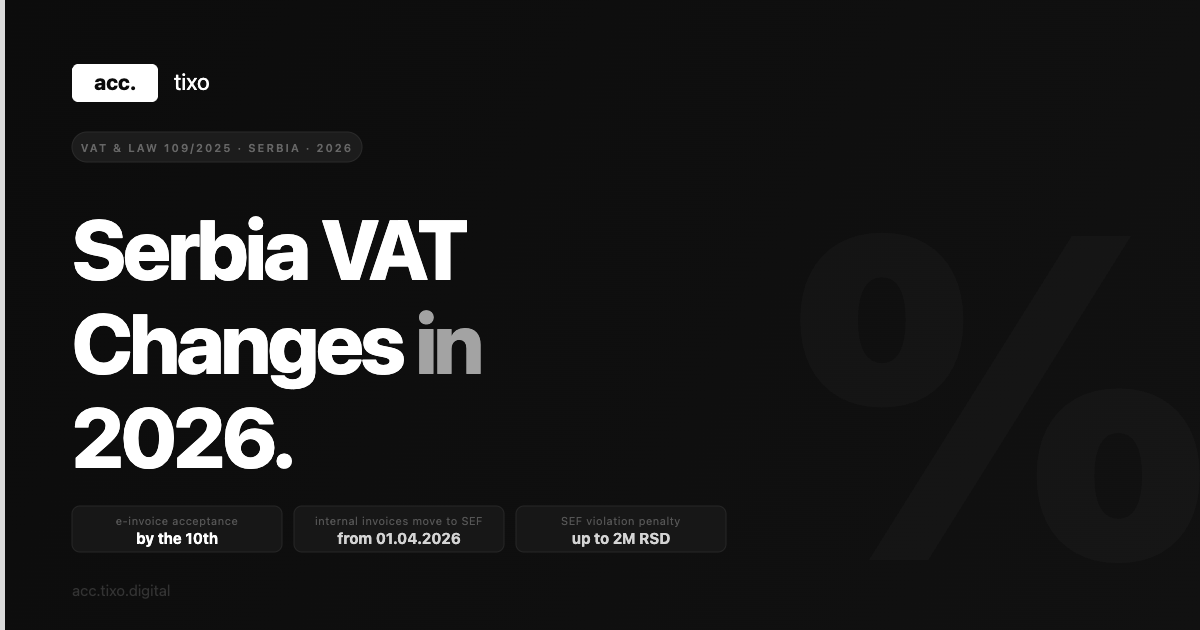
Serbia is entering a significant phase of VAT reform. The amendments introduced by Law 109/2025 (Zakon o izmenama i dopunama Zakona o PDV-u) bring structural changes to how VAT adjustments, e-invoicing, and reporting obligations work. Most provisions take effect in April 2026, with one key deadline pushed to January 2027.
This guide breaks down every change, when it applies, and what your business should do to prepare.
Timeline of Changes
| Date | What Happens | Legal Basis |
|---|---|---|
| April 2026 | Key VAT amendments from Law 109/2025 become effective, including new rules for VAT base adjustments and revised correction mechanisms | Law 109/2025 (application from April 2026) |
| After 31 March 2026 | E-invoicing law amendments (109/2025) apply for tax periods starting after 31.03.2026, except the preliminary VAT declaration transfer rule (effective immediately) | E-invoicing amendments 109/2025 |
| January 2027 | Preliminary VAT return obligation postponed from 2026 to 2027 under transitional provisions | Transitional norms, Law 109/2025 |
1. New VAT Base Adjustment Rules (April 2026)
The most impactful change concerns how businesses handle VAT base corrections after an invoice has been issued. Under the current system, corrections require a specific procedure tied to credit notes and the original tax period. Starting April 2026:
- Unified correction mechanism -- a single, clearer procedure for adjusting the VAT base when the original transaction terms change (price reductions, returned goods, cancelled services)
- Timing rules -- corrections must be reported in the tax period when the adjustment event occurs, not retroactively linked to the original period
- Documentation requirements -- new mandatory fields on correction documents, aligning with e-invoicing standards
This is a practical improvement. Under the old rules, many businesses struggled with the timing of corrections, especially when credit notes crossed tax period boundaries. The new approach simplifies this by anchoring the correction to the period of the event.
What to do now
Review your internal procedures for issuing credit notes and VAT corrections. If you use accounting software, confirm that it supports the new correction flow. The acc.tixo VAT calculator will be updated to reflect the new adjustment rules.
2. E-Invoicing Changes (Tax Periods After 31.03.2026)
Serbia has been rolling out mandatory e-invoicing (elektronsko fakturisanje) through the SEF system since 2022. Law 109/2025 introduces further amendments:
- Extended scope -- additional transaction types now require electronic invoices through SEF
- Correction invoices -- must follow the new VAT adjustment rules above, with structured data fields in the SEF system
- Cross-referencing -- e-invoices must now reference the original invoice number when issuing corrections, enabling automated reconciliation
- Preliminary VAT declaration rule -- the provision linking the preliminary VAT return to e-invoicing data applies immediately (not deferred to April)
The immediate applicability of the preliminary declaration link is notable. While the full preliminary VAT return is postponed to 2027, the infrastructure connecting SEF data to tax reporting is being activated now.
Impact on businesses using SEF
If your business already issues e-invoices through SEF, the transition should be smooth. The main change is in correction invoices -- ensure your invoicing process captures the original invoice reference. Businesses still using paper or PDF invoices for exempt transactions should check whether their transaction types now fall under the SEF mandate.
3. Preliminary VAT Return Postponed to January 2027
Perhaps the most discussed provision: the preliminary VAT return was originally scheduled to become mandatory in 2026. Law 109/2025 pushes this to January 2027.
The preliminary VAT return is a new reporting obligation where businesses would submit an estimated VAT return based on e-invoicing data before the final return. The idea is to enable early detection of discrepancies between reported sales and received invoices.
Why the delay?
The tax administration determined that the SEF system and business processes need more time to mature. Key concerns include:
- Not all businesses have fully adopted e-invoicing workflows
- The reconciliation algorithms between SEF data and VAT returns need further testing
- Small businesses (including pausalni entrepreneurs) need more time to adapt their accounting processes
What this means for 2026
For the current year, businesses do not need to file a preliminary VAT return. However, the infrastructure is being prepared, and the connection between SEF data and tax reporting is active. Treat 2026 as a preparation year:
- Ensure all invoices are issued through SEF where required
- Verify that your e-invoice data matches your VAT return figures
- Start reconciling SEF reports with your internal accounting monthly
4. Practical Checklist for Businesses
| Action Item | Deadline | Priority |
|---|---|---|
| Review VAT correction procedures | Before April 2026 | High |
| Update accounting software for new correction rules | Before April 2026 | High |
| Verify SEF compliance for all required transaction types | Before April 2026 | High |
| Implement original invoice referencing in correction invoices | Before April 2026 | Medium |
| Begin monthly SEF-to-VAT return reconciliation | Q2 2026 | Medium |
| Prepare for preliminary VAT return | Before January 2027 | Low (for now) |
5. How acc.tixo Helps
acc.tixo is built for Serbian businesses navigating exactly these kinds of regulatory changes:
- PDV evidencija + POPDV -- automated VAT records aligned with current and upcoming regulations
- SEF integration -- electronic invoicing through the Serbian SEF system
- VAT calculator -- free tool for quick VAT calculations at current rates
- Bank statement import -- automated reconciliation of transactions with SEF data
- AI-powered categorization -- intelligent transaction categorization that adapts to regulatory changes
As the April 2026 changes take effect, acc.tixo will automatically update its VAT adjustment workflows and correction document formats. No manual configuration needed.
Stay ahead of Serbian tax changes.
Try acc.tixo free for 14 days
Sources
- Zakon o izmenama i dopunama Zakona o porezu na dodatu vrednost ("Sluzbeni glasnik RS", br. 109/2025)
- Zakon o izmenama i dopunama Zakona o elektronskom fakturisanju ("Sluzbeni glasnik RS", br. 109/2025)
- Prelazne i zavrsne odredbe -- odlaganje preliminarne poreske prijave na 2027. godinu